A New Industrial Vision from the Ocean
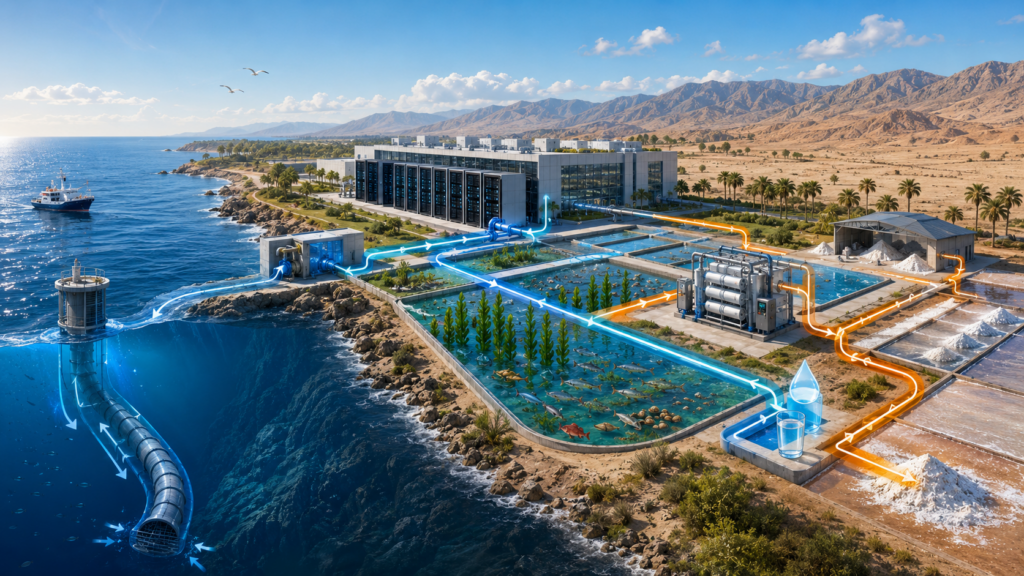
Lemurian Terraforming is a concept that harnesses the ocean’s natural temperature differences and water flows to connect deep ocean water intake, data center cooling, land-based aquaculture, desalination, and salt production into one continuous system. Rather than using seawater only once, the system makes sequential use of it for different purposes, creating multiple forms of value—including digital industries, food, drinking water, and salt—and establishing a new model for coastal industry.
Simple Natural Principles, Connected at Scale
This concept is supported by extremely simple principles found in nature: using cold water to remove heat, allowing water to flow from higher elevations to lower ones, and using water at different temperatures for different purposes. Rather than creating an entirely new and complex mechanism, the system rationally reconnects natural processes that anyone can understand and applies them at an industrial scale.
From One Flow, Many Values
1. Deep Ocean Water Intake
Cold, stable deep ocean water is conveyed to an onshore intake facility through a long intake pipeline. A high-capacity siphon-based intake pit serves as the hub for seawater use, while onshore pumps and flow-control equipment deliver only the required amount to each application.
2. Cooling AI Infrastructure
Cold seawater is used to cool data centers and efficiently recover heat generated by large-scale AI computing infrastructure. By utilizing this naturally cold resource, the system aims to reduce cooling loads and dependence on mechanical refrigeration.
3. Growing Seafood and Seaweed
Seawater warmed after cooling is sent to land-based aquaculture facilities to grow fish, shellfish, sea cucumbers, and seaweeds such as wakame and kombu. This allows animal protein and seaweed rich in dietary fiber and minerals to be produced from the same continuous flow of seawater.
4. Producing High-Quality Drinking Water
A portion of the seawater flowing through the system is desalinated according to water demand and treatment capacity. The resulting freshwater undergoes mineral balancing, pH adjustment, filtration, disinfection, and quality testing before being supplied as high-quality drinking water.
5. Turning Concentrated Seawater into Salt
The highly concentrated brine remaining after desalination is sent to a salt-production process, where additional water is removed to crystallize the salt. Instead of treating the concentrated seawater as waste, the system transforms it into high-quality edible salt.
Three Foundational Inventions
At the core of this integrated concept are three patent-pending inventions. Desalination and salt production are not themselves among these inventions; rather, they are positioned as additional processes integrated with the underlying technologies.
Invention 1|Neutral-Buoyancy Composite Pipe
This composite pipe is engineered to achieve near-neutral buoyancy, preventing it from floating excessively or sinking too deeply in seawater. It improves the feasibility of constructing long subsea pipelines capable of transporting cold deep ocean water reliably to shore.
Invention 2|Low-Cost Installation Method for Long Subsea Pipelines
Multiple pipe sections are progressively fusion-joined on land to form a long continuous pipeline. The pipeline is then launched into the sea over rollers and towed to the installation site. This method reduces dependence on large pipe-laying vessels and streamlines subsea pipeline installation.
Invention 3|Cooling–Aquaculture Integrated System
Deep ocean water is used to cool data centers, and the seawater warmed during the cooling process is then supplied to land-based aquaculture facilities. By utilizing recovered data center heat and seawater temperature, the system connects cooling and food production within a single continuous flow.
Transforming Coastal Drylands into Productive Ecosystems
Arid coastal regions near deep waters offer vast land, abundant sunlight, and underutilized marine resources. Lemurian Terraforming aims to integrate data centers, land-based aquaculture, desalination, and salt production in these regions, creating a sustainable economic ecosystem that generates food, water, digital industries, research and development, and employment.
Built to Expand
<p>This concept is not a single massive facility that must be completed all at once. It is a scalable industrial platform that can expand in response to demand and local conditions. The principal intake facilities and pipelines are designed with additional capacity, allowing pumps, aquaculture facilities, desalination units, and salt-production equipment to be added gradually and in parallel.</p>
Let’s Build the Future of the Ocean Together.
Lemurian Terraforming is seeking collaboration with companies, research institutions, and public agencies in fields including ocean research, data centers, land-based aquaculture, desalination, salt production, construction, environmental assessment, and research and development to advance the validation and commercialization of this concept. Together, we aim to bring a new ocean-based industry built on natural systems to the world.